What I learned composing for live quartet for the first time
Context: I immediately starting writing down what came to mind after the session which took place at 5:55am.
1. String players also need to breathe!
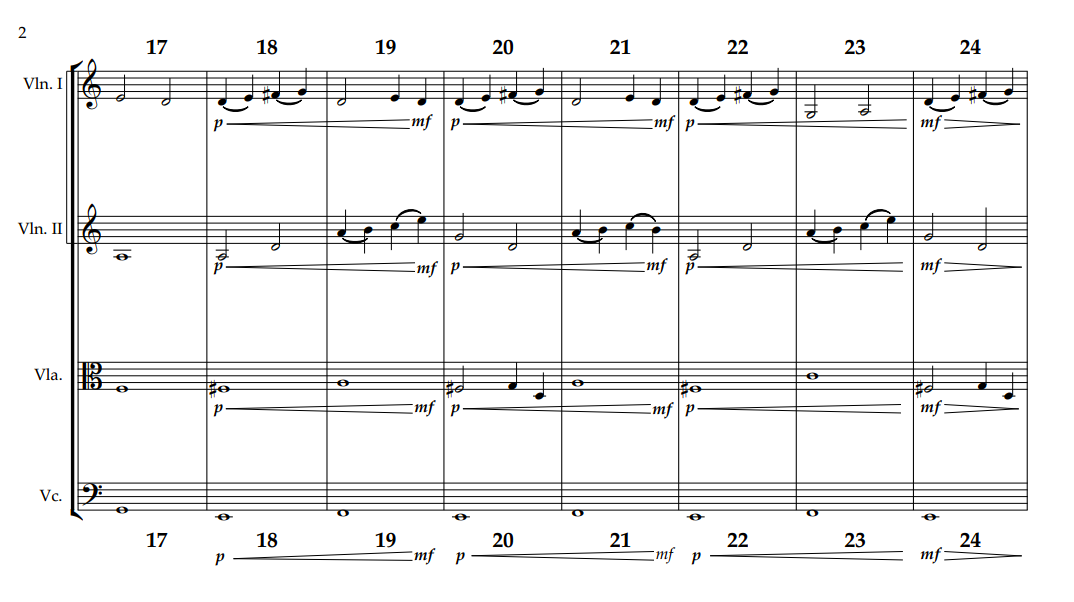
In my case it was this section in bars 18-24 where I had written p<mf back to p throughout.
This mf to p sounds nice and dramatic in samples with modulation and expression data but in real life with a quartet, everything is more exposed and as soon as the player switches the direction of their bow at a slow tempo to go back to p, you will hear a brief pause.
Running out of bow is like taking a breath (duh).
Unexpectedly, there was a significant pause that occurred when players hit the next measure at p and it wasn’t what I intended when composing.
In my feedback I asked for them to play more connected by playing mp instead of mf or whatever dynamic was natural for them at the end of the phrase in order to continue without such a big pause and save a little more bow and it really helped!
2. Always state the bars you’re giving feedback on.
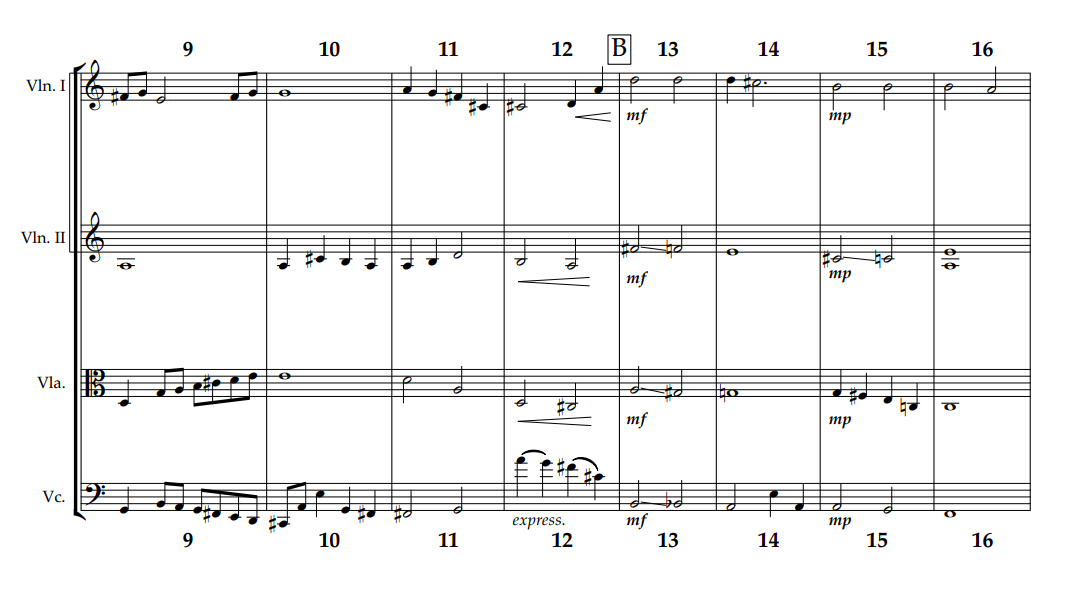
At the moment I thought that stating the rehearsal marking was enough, in this case section B, but it wasn’t and I had to clarify after they had already done another run through.
Immediately after, I clarified by stating the bars I was talking about and what dynamics I actually wanted to adjust.
In the piece there was a call and response type section where I had written mf for the first section (bars 13-14) and mp for the other section (bars 15-16). I simply asked them to contrast the dynamics of these two subsections and it worked!
3. What would I have done differently?
Not mock up anything. At all. Especially since this is string quartet and not a big ensemble.
I kinda wish I had written it without hearing it mocked up. I already felt that my core idea was good just sketching at the piano with paper and Sibelius, but I felt insecure about how it would sound overall.
As a composer, we have this awesome ability to imagine sounds in our minds and I wish I had trusted it more.
Before recording, I knew that it would not sound like the samples I mocked it up with, I reminded myself this many times- but I feel that just having made and listened to the mockup still affected the choices I made.
If you’re going to record a piece live, treat technology (digital notation software and sampled mockups) as a tool to capture ideas rather than a place to refine ideas.
4. Managing your own expectations: recorded music is NOT the same as performance music.
I already heard about this from more experienced composers but there’s nothing like experiencing it for yourself.
I knew that they would play a few run throughs and then record each section and adjust based on my feedback and it would not be recorded in full takes.
I just wanted to mention this because during the final stages of prepping the score, I discovered that I needed to include rehearsal markings.
No one had explicitly asked me to do this, but after a few Google searches and of course, reading up on NFO’s website, I knew that this was the expectation and it would make things easier.
5. How did the music in my head compare to the recording session?
This was my first time ever, so my expectations were very low. I had this irrational fear that what I wrote would sound terrible live and that I knew nothing about composing.
But despite all that, it was pretty close to what I had imagined!
And it’s not even mixed or mastered yet.
After the mixing and mastering are done, I’ll share an update again. I’m very happy with the results :)
6. Final thoughts?
It can only get better the more and more I compose and record for live players.
In all honesty, my expectations for myself and my music were so low that I can now confidently say that what I experienced has exceeded my expectations! If it sounds like I’m joking, I’m really not :D
I was surprised at how relaxed I was (maybe the fact that I’m in pajamas and it was before 6 in the morning) but it felt natural being there listening to the musicians and giving feedback. There were a few times when the judgmental voice in my head would creep in…
Ugh that’s how my voice sounds?
Was I nice enough to the musicians?
Am I being annoying with my feedback?!
But really, there was nothing to worry about.
At the end of the day, we’re all just here trying to make music!
Until my string quartet is out…
I’d like to leave you with an endearing recording of a string quartet that is supposedly by Benjamin Franklin. What I would give to hear any of my favorite composers’ first pieces. Ben here (clearly not known for his music) will have to suffice.
The point is, we all start somewhere and I’m glad I started my journey with composing for live musicians today. :)
. . .
I hope this was helpful! Feel free to ask questions about what it was like to record with the Northern Film Orchestra remotely or just anything you feel like I can help with.
Cheska Navarro is a media composer from San Diego, California. During her time in college, she realized that she had been pursuing her parents’ dream instead of her own and decided to fully embrace her creativity. Today she explores life as a creative introvert composing and documenting the journey.